

SCALE: Intelligence Everywhere -- 2
“One’s love of God should run before breathing.” 1
St. Gregory of Sinai
Let’s look at scale in human biology. “I contain multitudes.”2 This is another example of “As above, so below,” but now with “me” ostensibly as the “above.” Our bodies host interacting systems of microorganisms on scales we cannot see unaided; we are unaware of these systems unless something goes awry. Further, we are relieved of the energy expenditure and responsibility required to follow, with our minds, every minute maneuver within the body.
The autonomic nature of this interior world is a blessing. We may influence our body’s interior functioning, but we do not will it. There is another intelligence here, perhaps on this mechanical plane, but within life. How are we to grasp this, our house of telescoping scales, in continuous action, expressions of infinities everywhere? A cosmos, albeit tiny? A dark corner of a mini-universe, yet under my aegis and, in fact, operating me?

Might this indicate myself as the note DO, the seed, the potential, a beginning point before further branching? In Ouspensky’s In Search of the Miraculous, Gurdjieff said about the Rays of Creation:
“The Absolute gives birth to a number, perhaps to an infinite number, of different worlds, each of which begins a new and separate ray of creation. Furthermore, each of these worlds contains a number of worlds representing a further breaking up of the ray…”3
Let’s look at some of the branching as seen in the human digestive system. Here is a discrete new world on which many other “worlds” depend, a diverging of octaves. We cannot name it a Ray, with a DO, planets, sun, etc., but it is a forking of the mechanical world within life. To accept the operation of scales within scales we need to absorb the dynamic realities of dependence and inter-relatedness—large within small and small within large.
To accept the operation of scales within scales we need to absorb the dynamic realities of dependence and inter-relatedness—large within small and small within large.
We have a gut-brain axis.4 Within this axis, the enteric nervous system is called the second brain.5 It can operate outside the central nervous system, communicate directly with the brain, or operate on its own without input from the brain. The enteric system contains 200-600 million neurons.6 The communication between the brain and the enteric system, via the vagus nerve, is constant. Both “brains” contain neurotransmitters or chemical messengers; we have heard of dopamine and serotonin, for instance, which have garnered as much press as some celebrities. But even if the vagus nerve is damaged, the gut can still function because of this independent enteric nervous system.7 The enteric system and the gut-brain axis oversee a kingdom central to our well-being, governing confusion/clarity, hand stability, digestion, sleep, mood, behavior, memory, and more.
The two-way quality, or” bi-directionality”8 of communication between gut and brain, is just as important to emphasize as the independence of the second brain system. When the brain perceives a threat from outside, the gut tenses: it stops digestion and is on alert. And in the other direction—when the gut receives information from its interior of an encroaching foreign organism—the brain gets the picture right away, faster than a breath.
And just one more dive into the interior, into the bacteria, fungi, viruses, and protozoan organisms in the gut.9 How do they talk to the neurons? We can picture it as a lot of knocking on doors or bell-ringing. In fact, some information will arrive in that way and some via security cameras. Gut bacteria, or the microbiota, detect a pattern or an irregularity, and find the right neuron (not all neurons are alike, and the micro-organisms have a neuro-biotic sense10) to signal via chemical or electrical impulses. While the human gut contains two main microbes—from which phyla branch out into 30 to 40 main species—there are 1000 to 5000 different species of microbes which, in the gut, number altogether 100 trillion.11
We lose immune metabolic health; we now live a sanitized life. We have abused the generations after us. We have reduced scale and protected ourselves from Nature, which has provided everything we need. We miss the mixing of scale, the natural order of things.
Non-industrialized peoples’ digestive systems have a much more complex microbiota12 while industrialized persons suffer from lack of variation due to diet and antibiotics.13 We lose immune metabolic health; we now live a sanitized life. We have abused the generations after us. We have reduced scale and protected ourselves from Nature, which has provided everything we need. We miss the mixing of scales, the natural order of things.
While we can drill down into this elaboration endlessly—reducing scale in size, broadening scale in the infinite intricacies—we can return to this main point of branching and complexity. We can thank Walt Whitman for the poetic phrase “I contain multitudes.” The more I absorb that this deep variation lives in me and that I am supported from below, the more I am enlivened, as if my brain catches the significance and electrifies all the senses.
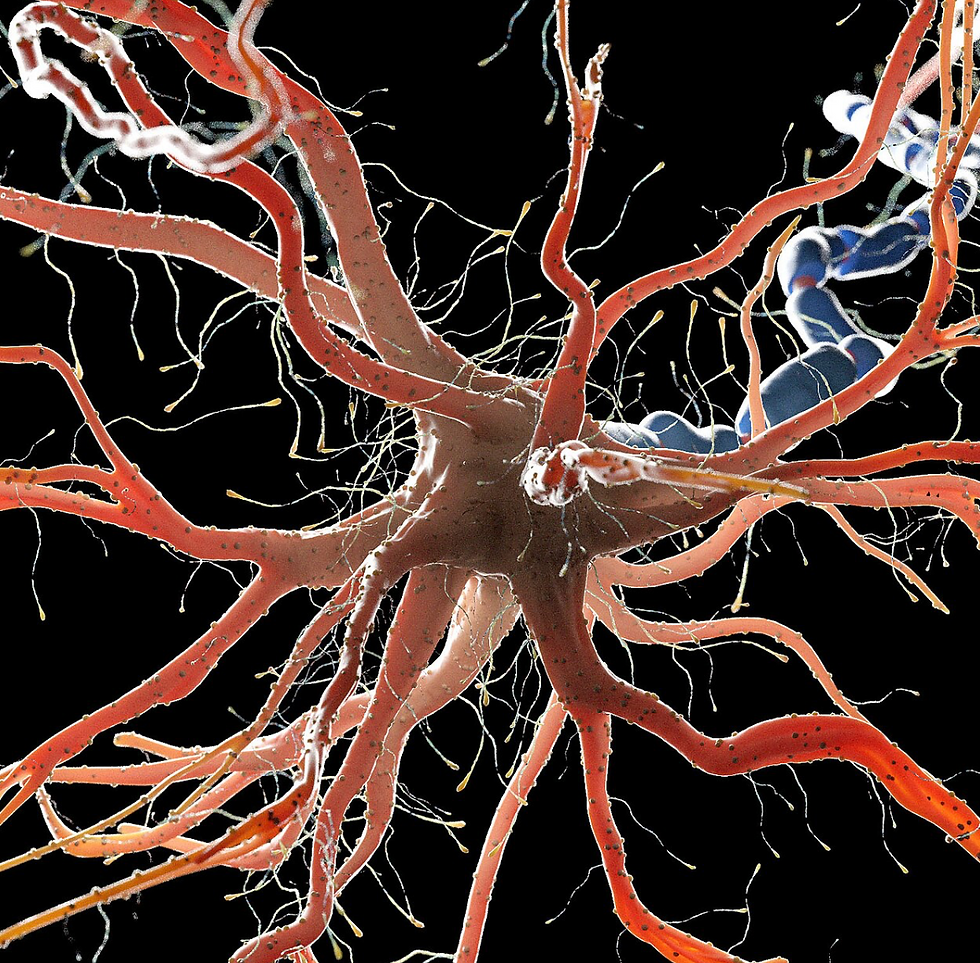
Before we leave the realm of digestion, let us put a lens on the relation of the gut to the emotional functions. Interestingly, the enteric nervous system is related to the thoracic-lumbar spine, where we find the heart center and solar plexus. The thoracic spine supports the ribs, protecting lungs and heart. Nerves run between this part of the spine and the gut and can override processes like digestion if deemed necessary. The very existence of neurons in the gut explains a dual functioning: we rely on our gut feeling as the most basic indicator of a truth when reason fails. There is a clear signal as reliable as a growling dog. The gut says, “Don’t take on this person as your roommate” or “Don’t hire this person as your assistant.” You find yourself sorry when you go against this instinct, very sorry. Our well-being, sometimes our very life, depends on this gut reaction.
What relationship to have with what we cannot see? Are we to emanate and send grace? Is it asked of us or even possible? It is not only that we are a grain of sand, but worse, as Gurdjieff said, that our Milky Way is but a grain of sand in the greater cosmos. And at the same time, we were given the possibility of consciousness, of evolving, however remote.
In the film Train Dreams, we see the older logger Arn Peeples sitting around a campfire with a crew of loggers at the end of the summer season of cutting. His years have taught him humility. In this conversation, two ideas of scale emerge.14
ARN: Y’all going on to another job, or you quitting for the season?
LOGGER 1: Mmm.
(Loggers murmuring]
I can’t decide.
I ain’t never happy when the job ends for some reason.
I just feel itchy inside.
ARN: That’s ’cause it’s rough work, gentlemen, not just on the body but on the soul. We just cut down trees that have been here for 500 years. It upsets a man’s soul whether you recognize it or not.
LOGGER 2: I’ll have $200 in my pocket tomorrow morning. Don’t bother my soul. Not one damn bit.
ARN: That’s ’cause you Minnesota fellas don’t know nothing about history.
LOGGER 1: These trees are really that old?
ARN: Why, some’s older even. This world is intricately stitched together, boys. Every thread we pull, we know not how it affects the design of things. We’re but children on this earth, pulling bolts out of the Ferris wheel, thinking ourselves to be gods.
LOGGER 2: That’s horseshit. I’ve been to Washington too. Cut all up through Canada and back down again. There’s enough logs for us to cut for 1,000 years. And then when the last one’s cut, well, first one will be growed up as big as anything around today.
ARN: I remember thinking the same thing when I was a young man… the very same thing.”
Beauty is a kind of scale, a measurement of wonder so that what is seen is understood as immeasurable. We see the ceiling in the Alhambra, the muqarnas, or honeycombed receding layers which eventually dissolve beyond our eyesight. It is mindboggling to think of how it was conceived and then made. A craftsman would not know where he was in the design, it is so dimensionally labyrinthine—yet it is. As we are taken into the ceiling’s infinity, we let it absorb us, slipping the bounds of our egos. It is beyond our grasping. This acknowledgement of what is beyond is a shift in our psychic self, a giant step. But with daily exposure to this humbling, not debasing ourselves—seeing in the tiniest thing what is outside our ken—we can join this greater scale. God’s breath is not so far away.
"This world is intricately stitched together, boys. Every thread we pull, we know not how it affects the design of things. We’re but children on this earth, pulling bolts out of the Ferris wheel, thinking ourselves to be gods."
Recognizing that in each moment we live in telescoping scales expands our sensitivity, like organic life on earth, the film that both absorbs and radiates. And way down here, in this Ray that lies in darkness for its remoteness from the Prime Source, we must wonder what greater force to muster. Like the gravitational force gluon that governs electrons and which is relatively much stronger than earth’s gravity—except that it operates in the micro-world—we are in need of our own force.
_________________
1 St. Gregory of Sinai, Writings from “The Philokalia,” “On Prayer of the Heart”, translated by E. Kadloubovsky and G.E.H. Palmer (London: Faber and Faber, 1951), 85.
2 Whitman, Walt, Song of Myself (Berkeley: Counterpoint Press, 2011), 123.
3 Ouspensky, P.D. In Search of the Miraculous: Fragments of an Unknown Teaching (New York: Harcourt Brace, 1949), 80.
4 Stanford Medical News Center, “The Gut-Brain Connection: What the Science Says—Long Covid, Anxiety, Parkinsons,” March 6, 2025.
5 Stanford Medical News Center
6 Zi-Han Geng, Yan Zhu, Quan-Lin Li, Chao Zhao, Ping-Hong Zhou, Neuroscience, Frontiers in Aging, “Enteric Nervous System: The Bridge Between the Gut Microbiota and Neurological Disorders,” April 19, 2022.
7 Healthline, Jill Seladi-Schulman, PhD, “What is the Vagus Nerve?” February 19, 2025.
8 Carabotti, Marilia; Scirocco, Annunziata; Maselli, Maria Antonietta; Severi, Carola, Annals of Gastroenterology, “The gut-brain axis: interactions between enteric microbiota, central and enteric nervous systems, April-June, 2015.
9 Geng, Zhu, Li, Zhao, Zhou
10 Magnify Magazine, Shantel Kirkendoll, writer, “Newly Discovered ‘Sixth Sense’ Links Gut Microbes to the Brain in Real Time,” discovery by Diego V. Bohórquez, Ph.D., Duke University School of Medicine, July 23, 2025.
11 Ferranti, Erin, Dunbar, Sandra B., Dunlop, Anne L., Corwin, Elizabeth J., Journal of Cardiovascular Nursing, “Things You Didn’t Know About the Human Gut Microbiome,” November 1, 2015, 20.
12 European Society for Neuro-gastroenterology and Motility, “Gut Microbiota for Health,” March 20, 2015.
13 Shatz, Nathan, “Recovering from GenZ’s Over-Sanitized World,” Wall Street Journal, April 18-19, 2026.
14 Train Dreams, Bentley, Bently, director, 2025. Screenplay by Chris Bentley and Greg Kwedar, based on a novella by Denis Johnson.